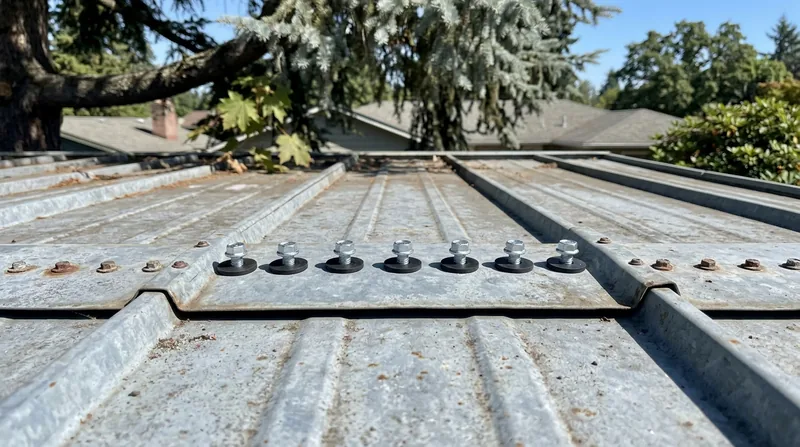




Eugene's metal roofs take a beating that most of the Willamette Valley never sees. Between the wet winters that soak the south and west slopes below Skinner Butte and Spencer Butte, the dry smoky summers that bake the panels from June through September, and the constant fir needles and bigleaf maple leaves packing into every pan and gutter, exposed-fastener roofs work hard. That cycle of swelling decking and expanding metal is exactly what backs screws out and cracks the washers under the heads. Screw replacement & re-fastening in Eugene is the fix that stops the drip before it reaches your sheathing, and it costs a fraction of what a new roof runs. We pull every backed-out and stripped fastener on the panel runs and at the flashings, replace the failed washers, and torque the new screws to the manufacturer's spec so the roof seals tight through another rainy season. On a 1970s ranch in Bethel or a barn shop out past Coburg, that usually means a few hundred screws and a day of work, not a re-roof. You can see how this fits our broader metal roof repair work when the fasteners are only part of the problem.
Why Backed-Out Screws Punish Eugene Metal Roofs
Lane County sits in a thermal swing that is hard on exposed fasteners. A 1990s two-story in the north valley can hit 95 degrees on a clear August afternoon and drop to the low 30s on a December night, and every one of those cycles pushes the metal panel against the screw head. The neoprene washer under that head takes the abuse until it hardens and splits. After that, water tracks down the shank and shows up as a brown stain on the ceiling below.
- Fir needles and maple leaves trap moisture along the panel seams, which accelerates washer cracking.
- Winter windstorms drop limbs on roofs and bend panels, which loosens the fasteners around the impact.
- Moss and algae growth on shaded north slopes holds water against the screw heads all winter.
- Older corrugated and ribbed panels often have screws that were over-driven at install and stripped the wood deck from day one.
We find these failures most often on the shaded, tree-heavy lots in Fairmount, Whiteaker, and the Jefferson Westside, where the roof never gets a full day of sun to dry out.
Key info: A 1980s ribbed-panel roof on a Cal Young ranch home came in with 60 percent of its washers cracked and 40 screws backed out a quarter inch. Replacing and re-torquing the fasteners cost a small fraction of a re-roof and stopped two active leaks that showed up over the kitchen.
For the official word on when a repair crosses into permit territory, check the City of Eugene building and permitting pages, and always confirm current rules with the local building department before work starts.
How We Re-Fasten a Metal Roof in Eugene, Step by Step
We start with a walk of the whole roof, not just the leak spot. Backed-out screws cluster around ridges, gable ends, and the downhill edge of panels where wind gets under the metal, so we map every bad fastener before we touch a tool. Then we pull, clean, and replace in a sequence that keeps the roof watertight as we go.
- We inspect the deck and panel runs from the ridge down, marking stripped, backed-out, and rusted screws.
- We remove each failed screw and check the hole for a stripped shank or enlarged opening.
- We install oversized replacement screws where the wood is stripped and standard fasteners where it is sound.
- We set every new screw with a UV-resistant EPDM washer and torque it to the panel maker's spec, never over-driven.
- We re-seal the penetration points at flashings, vents, and pipe boots as we go.
- We sweep the roof for metal shavings and blow out the gutters so the debris does not stain the panels.
You can see how this ties into our corrugated and ribbed panel roofing work when a panel run needs more than a fastener swap.
Key info: On a farm shop outside Junction City, the owner had already tried a tube of roof cement on every backed-out screw. We pulled all 214 fasteners, replaced the cracked washers, and reset the panels. The ceiling stayed dry through the next two winters.
Re-Fastening Approaches We Use on Eugene Roofs
Not every roof needs the same treatment. A lightly backed-out panel on a 2000s subdivision home in Creswell is a different job from a rusted-out corrugated barn roof in Veneta. We pick the approach from what the deck and the panels actually tell us.
| Approach | Description | Best for |
|---|---|---|
| Spot re-fastening | Replace only the backed-out and cracked-washer screws in the affected areas. | Newer panels with isolated fastener failures. |
| Full panel-run re-screw | Pull and reset every fastener on the panel runs, ridges, and eaves. | Roofs 15 to 30 years old with widespread washer cracking. |
| Oversized screw retrofit | Use larger-diameter screws where the original holes stripped the deck. | Over-driven or wind-loosened fasteners on older decks. |
| Washer and seal replacement | Swap hardened washers and re-seal the heads without moving the panels. | Roofs with sound screws but dried-out washers. |
| Panel and fastener replacement | Replace damaged panels and re-fasten the run when corrosion has taken hold. | Rusted corrugated and ribbed roofs on shops and barns. |
We tell you which one your roof actually needs after we walk it, not before.
Screw Replacement & Re-Fastening Cost in Eugene: What to Expect
Most residential re-fastening jobs in Eugene start at $750, and that figure covers a typical single-story roof with a moderate number of failed fasteners. A full panel-run re-screw on a larger two-story home in the Hendricks Park hills, or a shop roof out in Coburg, runs higher because of the square footage and the number of screws involved. The main cost drivers are roof size and pitch, how many fasteners have failed, whether the deck is stripped enough to need oversized screws, and access around trees and gutters.
We always recommend getting two or three estimates on a re-fastening job. The scope should list how many screws get replaced, what washer type is used, and whether flashings are re-sealed. A quote that only says "re-screw roof" tells you nothing. Our pricing overview breaks down what we charge and what is included.
Screw Replacement & Re-Fastening Near Me: Hiring a Contractor Around Eugene
You want a crew that has actually worked on exposed-fastener roofs, not a general roofer who treats metal like asphalt shingles. Get at least two written estimates so you can compare scope, not just price.
- Confirm the contractor is licensed and insured and can show a certificate on request.
- Ask for references from Eugene-area metal roof jobs, not just shingle work.
- Check whether a permit is required for your repair, and let the contractor handle the paperwork.
- Ask how the crew handles historic district or HOA rules if your home sits in a protected neighborhood.
- Get the fastener brand and washer spec in writing before work starts.
You can reach us through our contact page to set up a free inspection and estimate, and we will tell you straight whether re-fastening is the fix or whether the roof needs more.
Screw Replacement & Re-Fastening in Eugene: Pricing Guide
| Service | Price | Details |
|---|---|---|
| Spot re-fastening | Starting at $750 | Replaces isolated backed-out screws and cracked washers on a typical single-story roof. |
| Full panel-run re-screw | Starting at $1,450 | Pulls and resets every fastener on the runs, ridges, and eaves of a mid-size roof. |
| Oversized screw retrofit | Starting at $1,150 | Uses larger-diameter screws where stripped deck holes need a fresh bite. |
| Large two-story or shop roof | On estimate | Square footage, pitch, and fastener count need an on-site count before pricing. |
| Travel | Included | in Eugene and surrounding areas, no separate call-out or mileage fee |
| Estimate | Free | Response within 24h at (541) 743-7131, no obligation to book |
Indicative pricing, the exact cost depends on square footage, finish, and site access. Free personalized estimate within 24h at (541) 743-7131.


